Latest News

Todd Gilliland, K&N Pro Series West Rookie, Takes Checkered at Toyota Napa 150 in Idaho

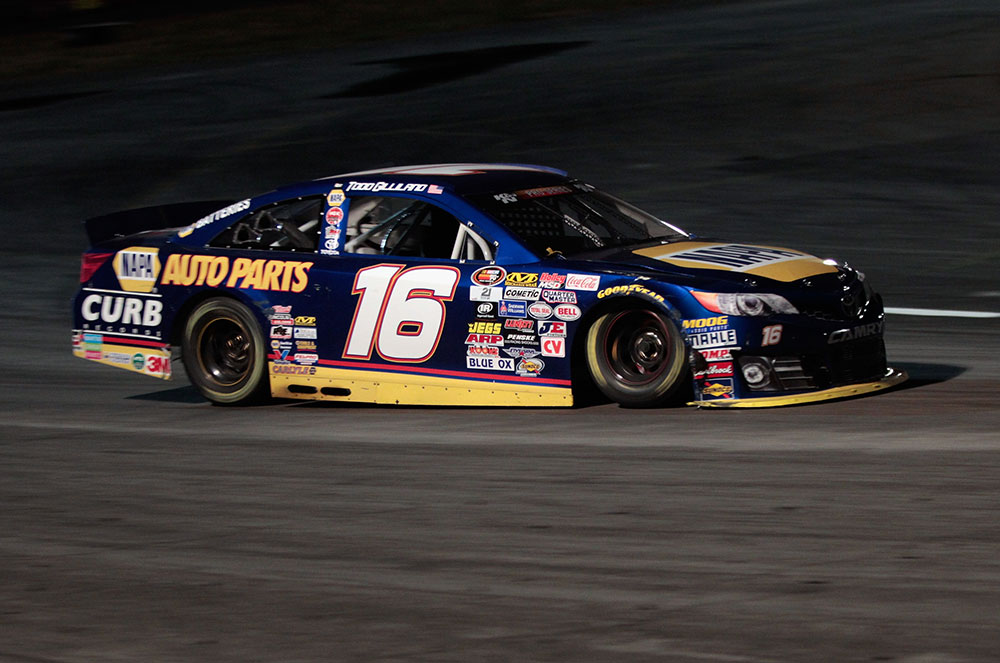
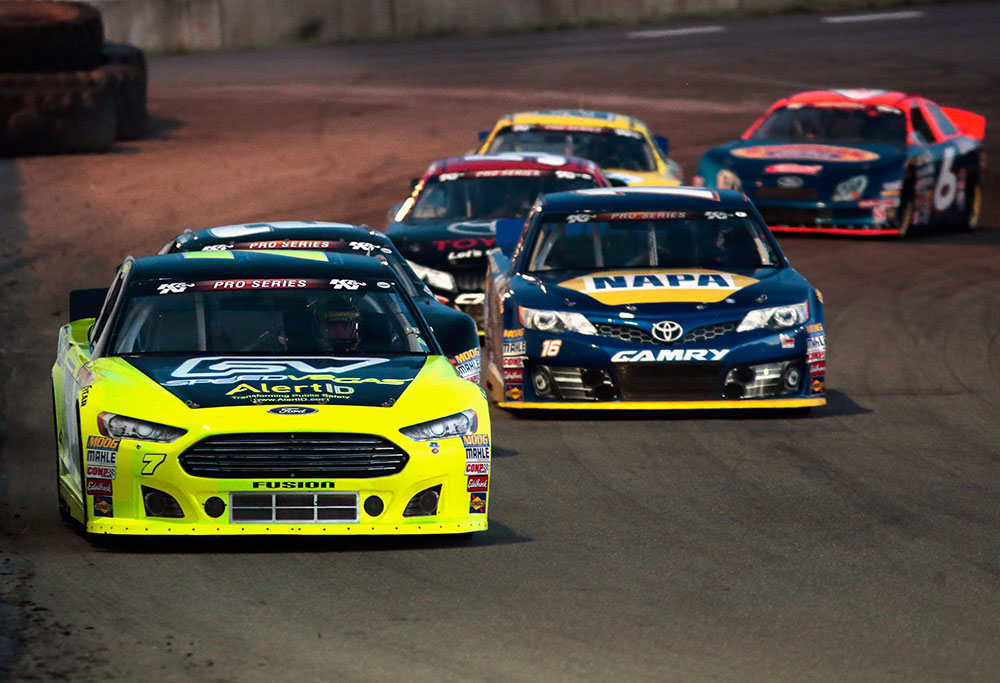
Todd Gilliland wins the NASCAR K&N Pro Series West race at Stateline Speedway in Idaho

Todd Gilliland won the NASCAR K&N Pro Series West race at Stateline Speedway in Idaho. He crossed the finish line .004 seconds ahead of Noah Gragson.

NASACAR K&N Pro Series West rookie Todd Gilliland broke a four-race drought by winning the Toyota NAPA 150 at Stateline Speedway in Idaho. Gilliland won the first two K&N Pro Series West races, but hasn't taken the checkered flag since April 2 at Kern County Raceway Park in California.

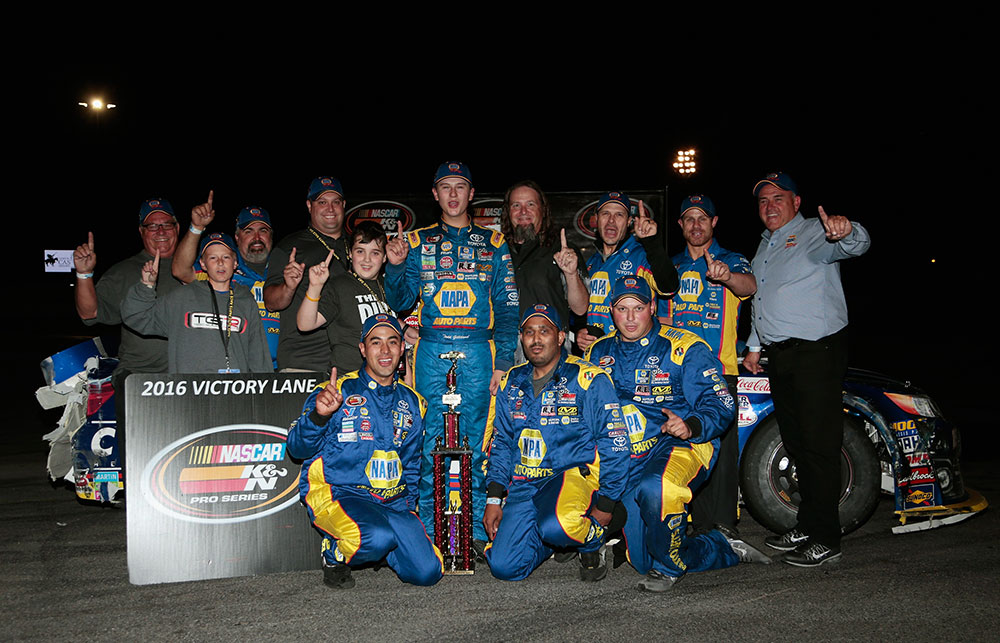
Todd Gilliland and his Bill McAnally Racing team win the NASCAR K&N Pro Series West race at Stateline Speedway in Idaho

Todd Gilliland and his Bill McAnally Racing team won the NASCAR K&N Pro Series West race at Stateline Speedway in Idaho. Gilliland won his third race of the season.

Gilliland beat Noah Gragson by .004 seconds on a green-white-checkered flag finish. The race was extended to 166 laps and two green-white-checkered attempts before Gilliland inched past Gragson, both part of the NASCAR Next class of drivers, at the finish line.

"I thought I had him at the line, but I'm sure he thought he had me at the line, too," Gilliland said. "It's just really stressful moments there sitting there watching the flagman standing between the two cars, not sure which one to give the flag to. The second he turned to my car and gave me the flag, it was a great sense of relief, just a great ending to a great day."

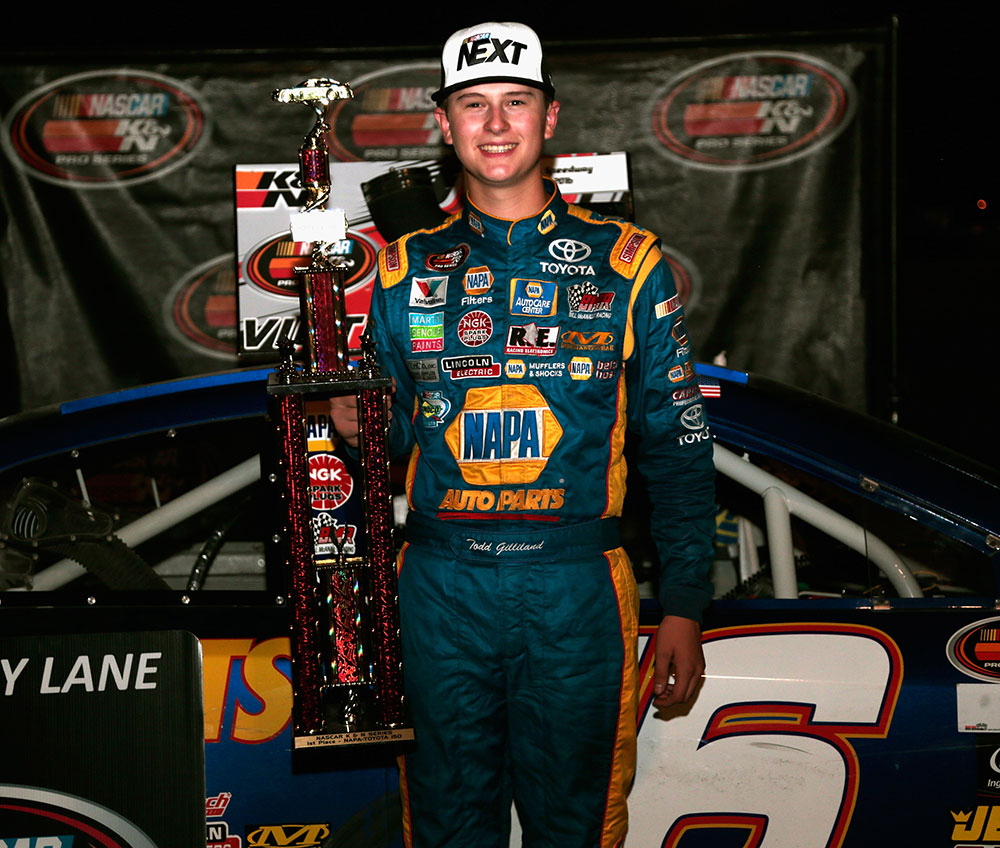
Todd Gilliland wins the NASCAR K&N Pro Series West race at Stateline Speedway in Idaho

Todd Gilliland won the NASCAR K&N Pro Series West race at Stateline Speedway in Idaho. He has won four NASCAR K&N Pro Series races in his career, three in the West Series and one in the East Series.

Gilliland started the race in seventh and didn't take the lead until the final lap of the race, lap 166. He probably didn't lead the race for more than a second, but the fraction of a second at the finish line was all he needed to win.

"It was great racing with Noah," Gilliland said. "Coming from the back there was kind of tough. Everyone on my team kept me calm. Get every car one by one. If they give it to you, take it."

The 16-year-old Gilliland won his third K&N Pro Series race of the season and the fourth K&N Pro Series race of his career.

"To be in a position to be on the outside there the last restart, we just tried to hang tough on the outside," Gilliland. "We knew it was probably going to come down to something like that where you're racing to the line pretty much."

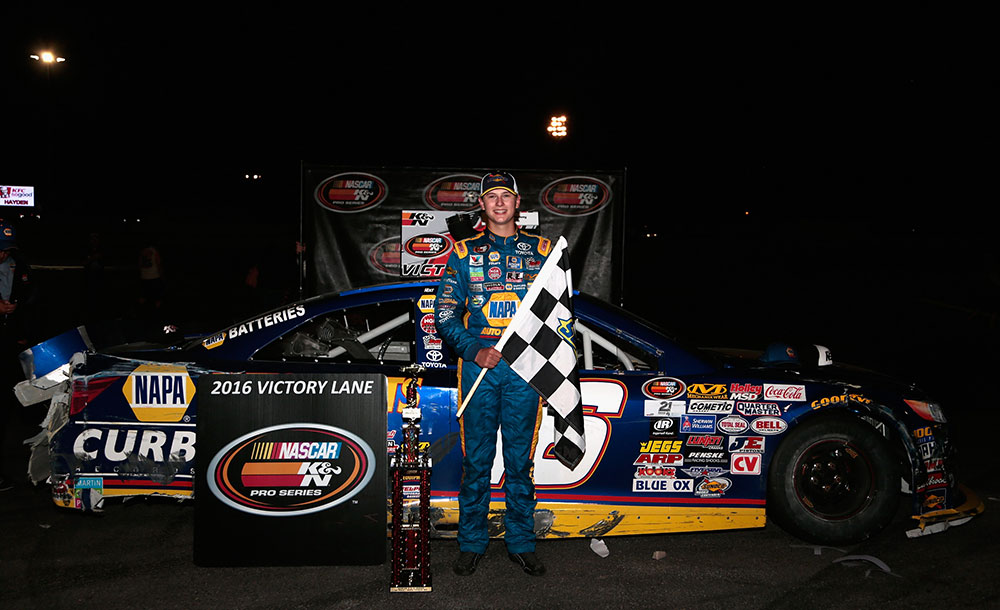
Todd Gilliland lead by a lap to win the NASCAR K&N Pro Series West race at Stateline Speedway in Idaho

Todd Gilliland led one lap in the NASCAR K&N Pro Series West race at Stateline Speedway in Idaho. The Toyota NAPA 150 was extended to 166 laps and two green-white-checkered flag finishes.

Gragson led for 26 laps on the tiny quarter-mile track. He took the lead from Ryan Partridge on lap 140, 10 laps from the scheduled end of the race. He was in the lead for both green-white-checkered flag restarts.

"I was the leader there coming to the green-white-checkered," Gragson said. "I felt like I was a little better on the bottom. I knew the top side, they could roll pretty good off the corner and get good drive by. I felt like my car was working better on the bottom. That was a crazy race there at the end. Unbelievable night. So close to being in Victory Lane. Can't complain with second. Great points day."

Noah Gragson was the runner-up in the NASCAR K&N Pro Series West race at Stateline Speedway in Idaho

Noah Gragson was the runner-up in the NASCAR K&N Pro Series West race at Stateline Speedway in Idaho. He led 26 laps in the race.

Chris Eggleston won the pole and led the most laps in the race, 73. Eggleston and Gracin Raz battled for the lead from laps 74 to 90. Eggleston crossed the finish line in third place.

"It's extremely hard to swallow," Eggleston said. "You don't get cars that drive that good that often. Felt like we did a halfway decent job of getting back up way through the field without running into anybody. Keep our heads high, keep digging and we go to Iowa."

Raz was fourth, followed by Julia Landauer in fifth.

Partridge was able to maintain his lead in the K&N Pro Series West standings with 291 points. He was 10th in the race at Stateline Speedway. Eggleston, the reigning K&N Pro Series West champion, is second in the standings, 13 points behind Partridge.

The next K&N Pro Series race is at Iowa Speedway on July 29. The drivers and teams from the K&N Pro Series West and East will be at Iowa Speedway for the Casey's General Store 150.

clear

K&N PRODUCT SEARCH     WHERE TO BUY K&N

clear

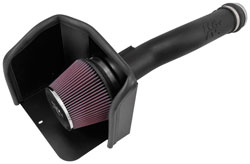
2016 Toyota Tacoma Air Intake Kit Increases Horsepower with 100,000 Mile Service Interval

K&N 63-9039 for 2016 Toyota Tacoma

The air filter in the K&N 63-9039 air intake system is washable and reusable. It will be the last air filter you will ever need.

Two engine options are available with the 2016 Toyota Tacoma – a 2.7-liter I-4 generates 159-horsepower and 180 lb-ft of torque and a new 3.5-liter V-6 engine that delivers 278-horsepower and 265 lb-ft of torque. The I-4 is mated to a six-speed automatic transmission and the V-6 is incorporated with a six-speed manual. When properly equipped with the V-6 tow package, the pickup can tow up to 6,800 pounds.

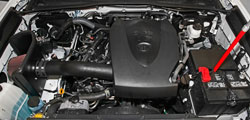
K&N 63-9039 air intake system installed in 2016 Toyota Tacoma

In about 90 minutes, your Tacoma can be breathing better air and making more power.

Along with the conventional airbags, the truck also includes knee airbags for the driver and front passenger. Available as an option is a blind spot warning system with rear cross-traffic alert.

Cloth upholstery, four-way driver’s seat, a Toyota Entune infortainment system featuring a 6.1-inch touchscreen, Bluetooth, a rearview camera, Siri Eyes Free, a USB port, and six-speaker sound system are standard.

Navigation is available on high level trims along with a smartphone app for the Entune, a 7-inch touchscreen, and a JBL premium audio system. The blue-collar vehicle sports a chrome-trimmed exterior and leather-lined interior and creature comforts including push-button start and plenty of smartphone integration.

The cabin is functional with a good number of places to store small stuff and includes Qi inductive charging for electronics devices you may normally bring with you. The control panel on the dashboard is center-stacked with easy-to-use knobs for climate control and for the infotainment system.

The vehicle has been manufactured in the United States since 1995. First considered to be a compact pickup, the truck was classified as a mid-size in its second generation. Motor Trend Magazine rewarded it as the 2005 Truck of the Year. The first generation model (1995-2004) was four-wheel drive and also came as a 2-wheel drive crew cab that was released in 2000 and is still available.

Three different engines were used to power the first generation models including:

  • A 2.4-Liter 4-cylinder rated at 142-horsepower and 160 lb-ft (217 N-m) of torque
  • 2.7-Liter 4-cylinder that generated 150-horsepower and 177 lb-ft (240 N-m) of torque
  • 3.4-liter V6 that delivery 190-horsepower and 220 lb-ft of torque

The truck was popular among young buyers during its first couple years. The Japanese-automaker unveiled a bigger and more powerful Tacoma in 2004, which marked the beginning of the second generation, which ran to 2015. It came in 18 different configurations including three cabs, four different transmissions, two engines and two bed lengths. The different cab styles included regular, access, and double.

A 4.0-liter 1GR-FE V6 engine replaced the original 3.4-liter. The new engine featured a tow rating of 6,500 lbs. and a payload capacity of 1,650 lbs., generated 236-horsepower and 266 lb-ft (361 N-m) of torque. A new 2.7-liter 2TR-FE 4-cylinder engine that delivered 159-horsepower and 266 lb-ft (361 N-m) of torque was available as an alternative.

The third generation of the Tacoma was introduced in September 2015. The K&N 63-9039 air intake system is specifically designed for the 2016 Toyota Tacoma. It is guaranteed to boost the horsepower and improve the throttle response and engine sound of the pickup.

Many automotive magazine staff writers who drove the 2016 Tacoma mentioned that it was somewhat sluggish. The K&N 63-9039 is specifically designed to dramatically decrease the air intake restriction that was caused by the factory intake and will smooth and straighten the airflow, which was also an issue. The air is directed through an aerodynamically engineered intake tube into the engine’s throttle body kit. As a result, the engine breathes in more air than the factory system assembly allowed. More air adds up to more power and acceleration throughout the engine’s RPM range.

The intake tube integrates with the factory mass air sensor, air temperature sensor and crank case vent hose. The air intake system includes a chrome topped K&N high flow air filter as well as a heat shield. The whole apparatus is designed to fit into the factory air box.

Included in the intake system is a K&N air filter that is specially designed to block contaminates from reaching the engine. The filter unique construction features four to six layers of cotton gauze media that is sandwiched between two aluminum wire screens. The cotton media is specially treated with a special grade of filter oil that causes the cotton microscopic strands to become extremely tacky so that it can catch and hold the contaminants for up to 100,000 miles.

K&N offers an air filter cleaner that is formulated to cleanse the used filter in seven steps in about 90 minutes. The filter can then be replaced into the intake system and reused for another 100,000 miles. Since the air filter washable and reusable in will be the last air filter you will ever need.

The K&N 63-9039 air intake system is used in the following vehicles:

2016 Toyota Tacoma 3.5L V6

You can view all the air intakes that K&N makes for the Toyota Tacoma at the Air Intake Systems for the Toyota Tacoma page and all the air filters that K&N makes for the Toyota Tacoma at the Air Filters for the Toyota Tacoma page. You can view all the K&N performance products for any vehicle by using the Search by Vehicle tool and you can find a local K&N retailer by plugging your location into the K&N Dealer Search as well.

clear

K&N PRODUCT SEARCH     WHERE TO BUY K&N

clear

Chris Ferguson Suffers Bad Luck Early Still Chalks Up Major Wins So Far in 2016

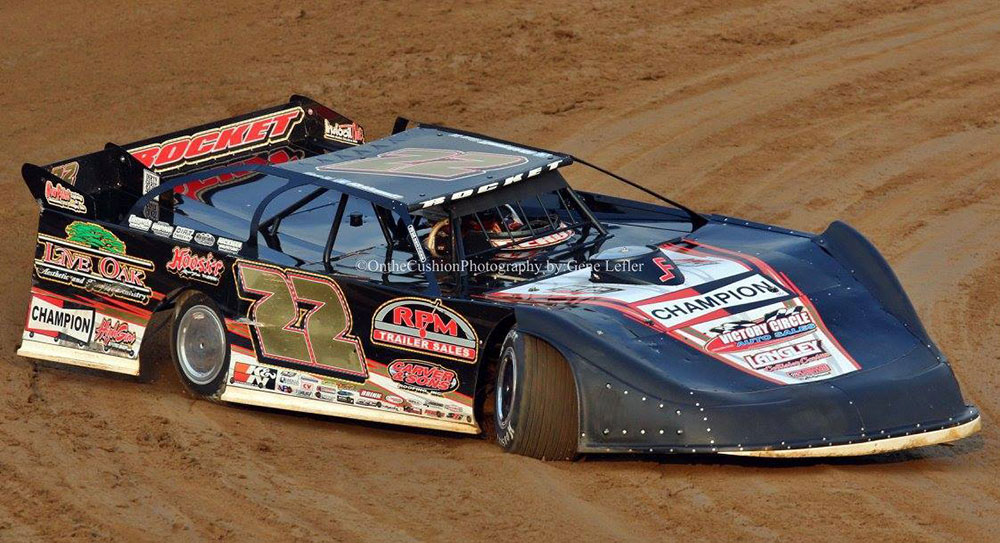
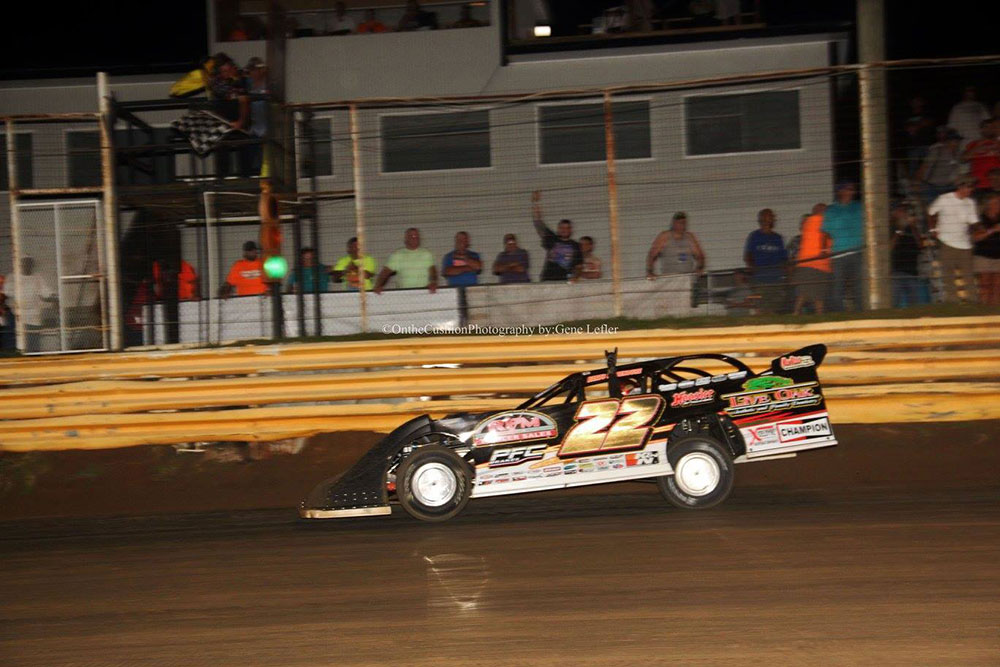
Chris Ferguson's #22 race car built by Butler Built Sports Equipment

Chris Ferguson's #22 late models racing car takes on a curve in a recent race.

"We've experienced some bad luck in three races so far this year," explained Ferguson, 26 and resident of Mt. Holly, North Carolina. "In one race we popped a tire with 10 laps to go; in another we were leading and crashed into the lap car; and in the third we had another flat tire."

Still, he has chalked up four wins racing late models so far in 2016 including the 37th running of the USA 100 at the Virginia Motor Speedway in Jamaica, Virginia. In addition, even though he doesn't concentrate on regional series, he still ranks third in points in the Ultimate Super Late Models Series and fifth in points in the Carolina Clash Series.

He has grown up in racing. His dad and his Uncles raced late models. "I grew up at race tracks watching my dad and uncles race," he said. "My dad bought me a go-kart when I was 13 and he took me to the local track to drive it. It wasn't long before I was racing. My dad quit racing at just about the time I got started so that he could focus on me and guide me through the sport."

Ferguson also works for Butler Built Sports Equipment, manufacturer of racing seats for more than 30 years.

Chris Ferguson's #22 race car built by Butler Built Sports Equipment

Chris Ferguson Motorsports' car 22 speeds passed excited spectators.

As an amateur racing go-karts, Ferguson won more than 100 feature races. Some of the main victories included the Daytona Dirt World Championship; the National World Karting Association (WKA) Championship twice; the WKA Grand Nationals, Jr. Kahuna, Goldspeed 100 and more. He graduated to Crate Late Models in 2006.

His dad formed the racing team in 2010 that includes Bryan Conard, Corey Tanner, Cory Henson, David Chapman, and Steven Outz.

He turned pro in 2011 and started racing late models at more national events.

"That's when I started winning races outside my home area. When I was an amateur I raced mostly in the Carolinas. Since I turned pro I race anywhere on the east coast from Pennsylvania down to Florida, in the Midwest including Indiana, Ohio and Illinois and in Tennessee, Virginia, West Virginia, and Louisiana," he said.

During his pro career he has won more than 50 special events races including two World of Outlaw championships, the top level of the sport. Other big races included The July 4th Special in Brunswick, Georgia; the Hall of Fame 100 at Cherokee Speedway in Gaffney, South Carolina; three-time winner of the Skylar Trull Memorial Race at the Carolina Speedway in Gastonia, North Carolina; World of Outlaw Blue Ridge Bash at Friendship Motor Speedway in Elkin, North Carolina; Ultimate at Golden Isle Speedway in Waynesville, Georgia; Ultimate Super Late Model Championship at the Virginia Motor Speedway; and more.

He also holds the current track record at the Carolina Speedway; Toccoa Speedway in Toccoa, Georgia; Dublin Motor Speedway in Dublin, North Carolina; and the County Line Raceway in Elm City, North Carolina.

According to Ferguson, there are 20 to 25 feature races left in this season in Illinois, Ohio, West Virginia, Virginia, North Carolina and South Carolina.

The weekend of July 9-10, Ferguson and his team will make a three race swing through North Carolina, South Carolina, and Tennessee.

"We will be racing in the Lucas Oil Late Model Series," he said. "There are three different races in three different states with the winner getting $10,000 for each race."

He chooses the races in which he will compete based on the size of the purse.

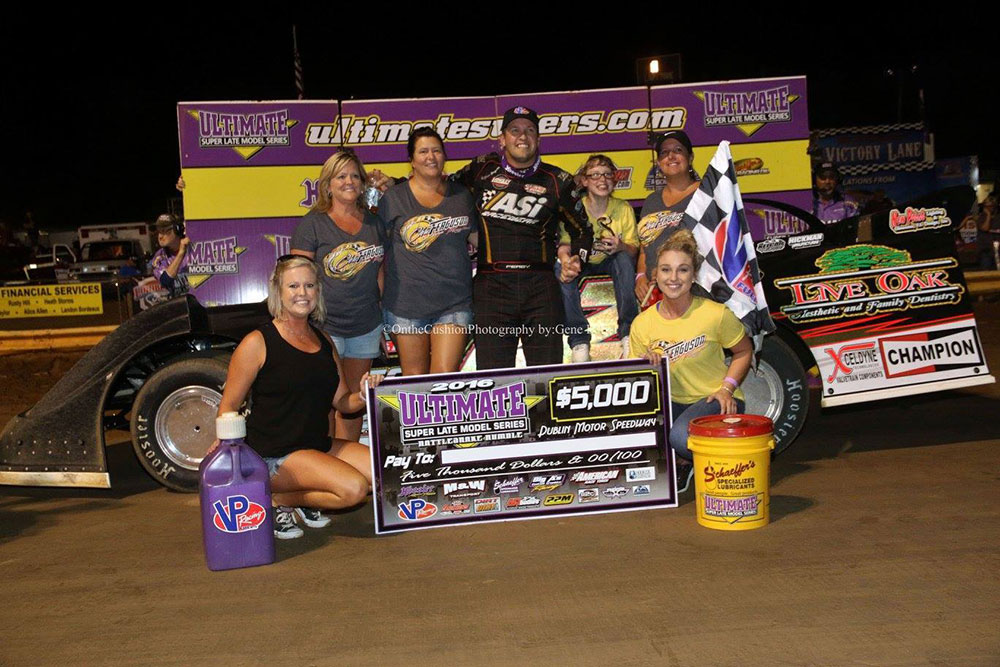
Chris Ferguson victory at 2016 Ultimate Late Model Series Championship at Virginia Motor Speedway in Jamaica, Virginia

Chris Ferguson celebrates victory at the 2016 Ultimate Late Model Series Championship at the Virginia Motor Speedway in Jamaica, Virginia.

"There are a lot of national races that have large purses," said Ferguson. "One pays $48,000 to the winner and is scheduled for September. There's another that pays $100,000 to the winner in Ohio in October and on and on. I'm drawn to races like that. A national race can pay $50,000 to $100,000 to the winner."

In the coming months he will compete in:

  • The Prairie Dirt Classic in Fairbury, Illinois for a purse of $26,000 in July.
  • The North-South 100 at the Lawrence Speedway in Lawrence, Kentucky in August for a purse of $50,000
  • The World 100 at the Eldora Speedway in Rossburg, Ohio in September.
  • The Dirt Track World Championships at Fort Smith Raceway Park in Fort Smith, Arkansas for a purse of $100,000 in October.
  • The USA 100 at the Virginia Motor Speedway in Jamaica, Virginia for a purse of $20,000.
  • The World Finals in Charlotte, North Carolina for a purse of $100,000 in November.
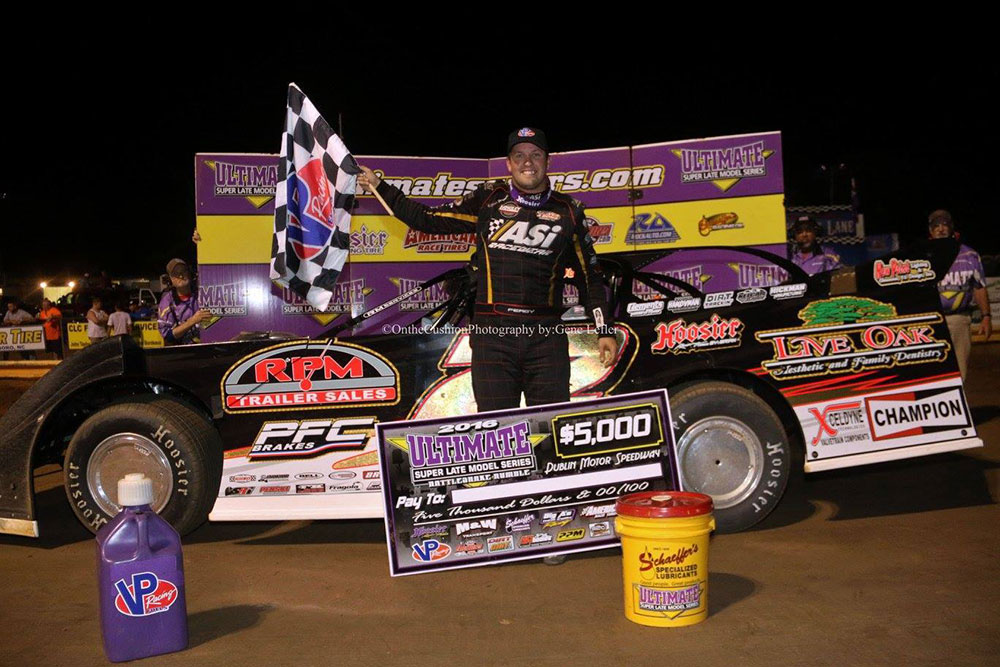
Chris Ferguson victory at 2016 Ultimate Late Model Series Championship at Virginia Motor Speedway in Jamaica, Virginia

Chris Ferguson holds the checker flag as he enjoys his victory at the 2016 Ultimate Super Model Series Championship at the Virginia Motor Speedway in Jamaica, Virginia.

"The World Finals is the season finale for the World Outlaw Late Models, World Outlaw Sprint Cars and big block modifieds ," explained Ferguson. "It's a big event that takes the weekend during which two races will be run. It concludes the season and it's a local race for me."

K&N Engineering has been sponsoring Ferguson since 2010.

"The relationship has been phenomenal. I've been very fortunate to work with Bob Harris initially and then during the last four years with Ryan Feldman. They have great products. Before they sponsored me I was running with K&N products for at least 10 years from my go-kart days through the Late Models. It was a product we already believed in. It's been great because of the following they have. Being supported by a brand that has been supporting racing for as long as it has is great for my team. I have been using K&N air filters and oil filters and their pre-filter since I have been racing go-karts. I've been using K&N products down to the air filter cleaners, the degreaser, and the air filter oil. Clements Racing Engines is also a sponsor and my engine builder. They've been in business for 35 years and is one of the top engine builders for dirt super late models. Before they knew I was using K&N products, they recommended them to me," he said.

Other companies sponsoring Ferguson include:

Langley Collision Center
Champion Spark Plugs
Carver & Sons Roofing
Victory Circle Auto Sales
Penske Racing Shocks
Keith's Handyman Services
Hoosier Racing Tire
Harkey Racing
Hickman Fabricating
Fluidyne High Performance Radiators
Frankland Racing
Bell Helmets
Draco Racing
Brinn
Weld Racing
Outerwears Performance Products
Wear3Wide.com
GW Performance
Maxima
Big A's Custom Graphics
Quality Fasteners
FK Rod Ends
Indocil Art
PFC Brakes
Butler Built
Keyser
Fragolia Performance Systems
Hi-Bridge Automotive
VP Racing
Hooker Harness
CV Products
Stock Car Steel & Aluminum, Inc.
SRI
Clements Racing Engines
Kelcar
ASi Racewear
Wheels Love
Sparco
Schoenfeld Headers
Dirt Trackin'
RPM Truck & Trailers
MSR Mafia

clear

K&N PRODUCT SEARCH     WHERE TO BUY K&N

clear

2011-2014 Ford F-150 Blackhawk Induction Air Intake System Guarantees Added Power

Caption

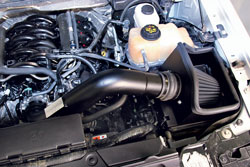
The K&N 71-2581 Blackhawk Induction air intake system is guaranteed to boost horsepower, enhance throttle response, and improve engine sound.

The best selling vehicle in the United States since 1981, the Ford F-150 is part of a series of light-duty and medium duty trucks known as the F-Series, which was first introduced by Ford Motor Company in 1948. It has been produced in 13 different generations and has won a number of awards including Motor Trend 2009 Truck of the Year, 2009 Best Redesigned Vehicle from Kelley Blue Book's kbb.com, Best Overall Half-Ton Pick from PickupTrucks.com, Automotive Excellence Award in the Workhorse Category from Popular Mechanics, Top Safety Pick from the Insurance Institute for Highway Safety, Residual Value Award from Automotive Leasing Guide, Motor Trends Truck Trend Top 5 Pickups from Specialty Equipment Market Association (SEMA), and Accessory-Friendly Pickup Design Award from SEMA.

The F-150 was actually introduced in 1975 (the sixth generation of the F-Series) to satisfy emission control restrictions and slotted between the F-100 and the F-250.

K&N 71-2581 Blackhawk Induction air intake system installed into a Ford F-150

K&N 71-2581 Blackhawk Induction air intake system installed into a Ford F-150

In 1980, which marked the beginning of the seventh generation of the F-Series, the F-150 XL was introduced. It was part of a redesign of the F-Series that included an all new chassis and larger body. It was the first ground up redesign since 1965 and included improved aerodynamics and fuel economy. The better fuel economy was due to a new 4.2-liter 255 C.I. and 5.8-liter 351 C.I. Windsor V8 engines. In 1983, Ford added a diesel power engine to the F-Series as a result of a partnership with International Harvester (later known as Navistar). This 6.9-liter, 420 C.I. IDI V8 generated similar power as the gasoline 351 Windsor V8 with better fuel economy. Electronic fuel injection was introduced in 1985 as part of a 5.0-liter V8. A new higher output engine debuted in 1984.

In 1983, the F-100 was discontinued, making the F-150 the lightest pickup on the market. Up to that time, the F-100 and F-150 were virtually identical. However, the F-100 featured smaller brakes and 5x4 five bolt pattern axles while the F-150 had 5x5.5 bolt pattern on the axle.

1986 was the last year that the F-150 featured a 3-speed manual gearbox that shifted through a steering column lever. The seventh generation S-Series was when amenities that included power mirrors, power windows, and power door locks first appeared.

The twelfth generation of the F-Series was on the roads from 2009-2014. It was in this period that a major focus on fuel economy resulted in a change of the entire engine lineup that powered the F-150. For the 2011 model year, two new V8 engines were introduced as well as a 3.7-liter base V6 and a turbocharged 3.5-liter V6, called EcoBoost by Ford. An automatic gearbox was the only option. In addition, there were other modifications including a Nexteer Automotive Electric Power Steering system on most models.

Ford has raced the F-150 through the early 2000s. The truck won the San Felipe 250 eight times between 1999 and 2007. It also won the 2000 NASCAR Craftsman Truck Series as well as the Primm 300 in 2003, 2007, and 2008. It also raced in the 2008 Baja 1000, completed the race in 25.28:10 and ranked third in its class. It won the Baja 1000 in 2010.

The most popular vehicle in the United States and a third place finisher and also winner of the Baja 1000 shows that the F-150 pickup truck is worthy of the best protection on the market. In this application, it is the K&N 71-2581 Blackhawk Induction air intake system.

It includes a free-flowing, mandrel-bent aluminum tube and it is guaranteed to boost power by an estimated 7.98 hp. It is designed to replace the restrictive factory air filter and air intake housing on some Ford F-150 models. The system permits the engine to breathe in a larger amount of air than it received via the factory air intake and the result is more power and acceleration.

The kit includes black components, a K&N high flow air filter and heat shield. The filter can be washed after 100,000 miles with a K&N air filter cleaning kit and can then be reused. The fact that the air filter is washable and reusable means that it could be the only air filter you will need for your Ford F-150.

The 71-2581 Blackhawk induction air intake system has a very neat appearance. The tube is covered in a black-powder coating and features a welded, engraved K&N plate. The intake tube integrates with the factory mass air sensor, EVAP hose and crank case vent hose.

The over-sized cone shaped air filter is made from an oil-free synthetic filter media that can be used for up to 100,000 miles before cleaning depending on driving conditions.

The air intake takes about 90 minutes to install and you can use the existing factory mounting points and common tools to complete the task.

The K&N 71-2581 Blackhawk Induction air intake system can be used in the following vehicles:

2014 Ford F150 5.0L V8
2013 Ford F150 5.0L V8
2012 Ford F150 5.0L V8
2011 Ford F150 5.0L V8

You can view all the air intakes that K&N makes for the Ford F150 at the Air Intake Systems for the Ford F150 page and all the air filters that K&N makes for the Ford F150 at the Air Filters for the Ford F150 page. You can view all the K&N performance products for any vehicle by using the Search by Vehicle tool and you can find a local K&N retailer by plugging your location into the K&N Dealer Search as well.

clear

K&N PRODUCT SEARCH     WHERE TO BUY K&N

clear

2016 Chevrolet Camaro SS Air Filter Delivers Reusable High-Flow Performance

Caption

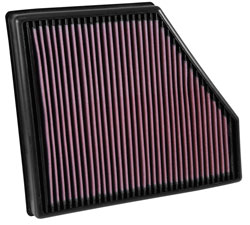
The K&N 33-5047 replacement air filter is washable and reusable and will be the last air filter you will ever buy.

Perhaps the embodiment of the muscle cars of the 1960s is the Chevrolet Camaro. First introduced on September 29, 1966 for the 1967 model year, it was designed to be Chevrolet's answer to the Ford Mustang; the original model shared its platform and major components with the Pontiac Firebird, which was introduced the same year.

Caption

The K&N 33-5047 replacement air filter integrates with the OEM vehicle electronics and will not void the vehicle warranty.

The Camaro went through four generations during the next 35 years, was discontinued in 2002 and re-introduced first as a concept car and then as a street model in March 2009.

The first Camaro was available as a two-door coupe and convertible. Buyers were given a choice of three engines –- a 230 cubic inch (3.8-liter), a 250 cubic inch (4.1-liter) inline-6 or a 302 cubic inch (4.9-liter), a 307 cubic inch (5.0-liter), a 327 cubic inch (5.4-liter), a 350 cubic inch (5.7-liter) a 396 cubic inch (6.5-liter) or a 427 cubic inch (7.0-liter) V8 engine. The first generation Camaro continued on into the 1969 model year and was the inspiration for the design of the retro fifth-generation Camaro that debuted in 2009. During the first generation run between 1967 and 1969, Chevrolet introduced four editions of the car –- a standard, Super Sport (SS), Rally Sport, and the Z/28.

The second generation Camaro debuted in 1970 and was produced through the 1981 model year. The car featured unibody construction, front subframe, an A-arm front suspension, and leaf springs to keep the solid rear axle under control. The staff at Road & Track selected the 1971 SS350 as one of the 10 best cars in the world in an edition of the magazine that broke in August 1971. The SS package was discontinued in 1972 and reintroduced in 1996. The 1980 and 1981 Z28 included an air induction hood scoop.

The run for the third generation Camaro was from 1982 through 1992. The car included fuel injection, Turbo-Hydramatic 700R4 four-speed automatic transmission or a five speed manual transmission and a standard OHV 4-cylinder engine. Besides the coupe, there was also a hatchback model. This incarnation was 500 pounds lighter than the second-generation model. In addition, the IROC-Z (which stands for International Race of Champions) was added to the stable in 1985 and lasted through 1990. In 1985, Chevrolet paired the Camaro with a 305 block V8 with turned port injection (TPI) and in 1987 a 350 cubic inch (5.7-liter) V8 engine was available as an option to power the IROC-Z with an automatic transmission.

Chevrolet celebrated the 20th anniversary of the Camaro with two special editions – the 20th Anniversary Commemorative Edition in 1987 and the 25th Anniversary Heritage Package in 1992. The Heritage Package was powered by a 305 cubic inch (5.0-liter) High Output engine.

A police version of the Camaro, a combination of the Z28 and the RS, was unveiled in 1991.

The fourth generation of the Camaro first appeared in 1993 and ran through 2002. It was basically the same car as the first model that was introduced in 1967. It included rear-wheel drive, pushrod 6-cylinder V8 engines. In addition, from 1993 through 1995 the car was also powered by a 3.4-liter V6. A 3.8-liter V6 was debuted in 1995. A 350 MPFI (LT1) small block V-8 engine from the 1992 Corvette also powered the standard Z28.

The fifth generation Camaro covered the years of 2009 through 2015. It was totally redesigned based on the 2006 Camaro Concept and 2007 Camaro Convertible Concept and was approved for production in August 2006. GM Holden in Australia directed the creation of the final design and performed engineering and development of the car because it had been instrumental in the development of the Zeta Architecture and was General Motors' global center for Rear-wheel drive development. The standard coupe, the LS, LT, and SS were the available models. A 3.6-liter (220 cubic inch) V6 powered the LS and LT and generated 312-horsepower. The SS gets its power from a 6.2-liter (376 cubic inch) LS3 V8 that produced 426 horsepower. The automatic version of the SS featured the L99 V8 that generated 400-horsepower. In April 2010 the Camaro was selected the World Car Design of the Year at the World Car of the Year Awards.

The sixth generation Camaro was introduced in 2016 and was available in an LT and SS model. There are three engine available to power the vehicle –- a 2.0-liter turbocharged inline 4 that produces 275-horsepower, a 3.6-liter V6 that offers 344-horsepower, and a 6.2-liter LTI V8 that supplies 455-horsepower powers the SS model.

The Camaro has competed in the SCCA-sanctioned Trans-Am Series, the NASCAR Xfinity Series and was the official car of the International Race of Champions from 1975 until 1989. It is also a favorite of drag racers and has won several championships and is competing in series sponsored by the National Hot Rod Association, International Hot Rod Association, the United States Hot Rod Association, the Sports Car Club of America, the IMSA GT Series of the Grand Am Road Racing Championship, and the Swedish Camaro Cup

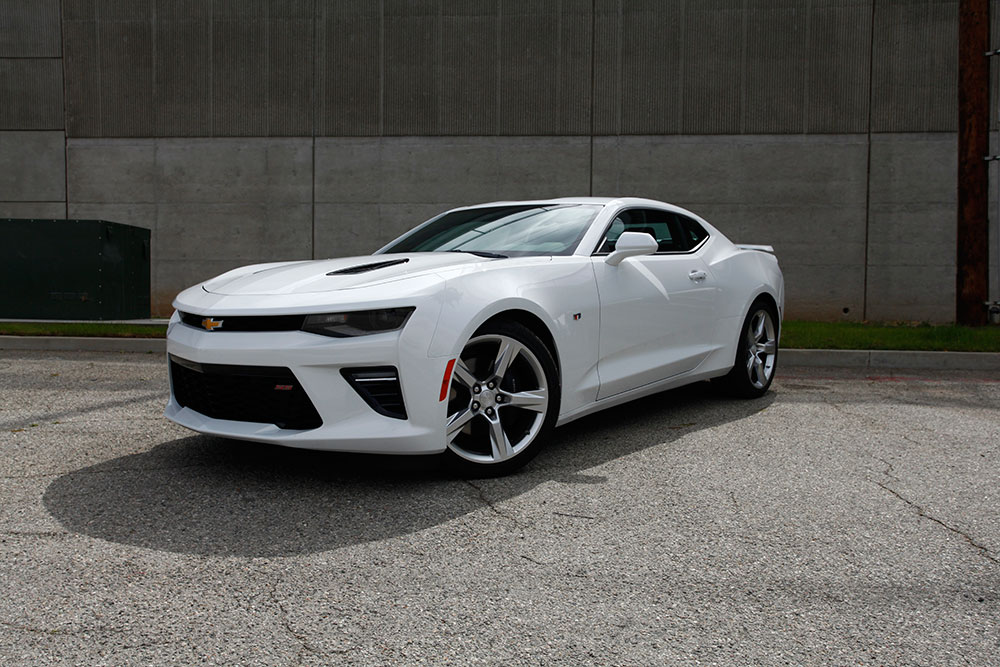
It would surely be ashamed if you owned a 2016 Chevrolet Camaro SS with a 6.2-liter V8 engine and not protect it with the best replacement air filter around –- the K&N 33-5047 replacement air filter.

The filter is designed to boost horsepower and acceleration, works with the OEM vehicle electronics, lasts for up to 50,000 miles and is washable and reusable. In fact, it could end up being the last air filter you will ever need to buy for your 2016 Camaro SS.

The filter performance is impeccable because of its design. It features four layers of cotton gauze media that lies between two aluminum wire screens. The cotton media is treated with a special grade of filter oil that is so tacky it catches and holds impurities that could damage your engine.

K&N also offers an air filter cleaning kit that restores its original performance capabilities in just seven easy steps in about 90 minutes. K&N is so sure of the performance of its air filters it backs them with a Million Mile Limited Warranty.

Nothing has been left to chance in the development of the filter. The Society of Automotive Engineers developed the standards under which the air filter is tested and K&N's own in-house lab tests each filter

The K&N 33-5047 air filter is specifically designed for the 2016 Chevrolet Camaro SS with a 6.2-liter V8 engine.

You can view all the air intakes that K&N makes for the Chevrolet Camaro SS at the Air Intake Systems for the Chevrolet Camaro SS page and all the air filters that K&N makes for the Chevrolet Camaro SS at the Air Filters for the Chevrolet Camaro SS page. You can view all the K&N performance products for any vehicle by using the Search by Vehicle tool and you can find a local K&N retailer by plugging your location into the K&N Dealer Search as well.

clear

K&N PRODUCT SEARCH     WHERE TO BUY K&N

clear