Latest News

Dave "Sideways" Sieders Wins Last Australian V8 Ute Series in Final Race At Sydney Olympic Park

Even though the Utes are designed for light off road, teams can reinforce the suspension

Dave "Sideways" Sieders hits the curbs hard at Sydney Olympic Park en route to the champsionship

With the brief exception of the El Camino and Ford Ranchero of the 1960s and 1970s, Americans have never really embraced the concept of a coupe front half, and a smaller open truck bed for the back half. There’s actually a term in the automotive industry to describe these vehicles: Coupe Utility.

One place that’s long accepted the Coupe Utility concept is Australia, where they’re referred to as Utes. And while some Utes Down Under are used to drive from Sheep Stations (ranches) into town, Utes with big V8s have also been tearing up the streets of Melbourne, Sydney, Perth, and every town in-between for decades.

So popular has the high-performance Ute category become, they have their own racing series starting in 2001. Run in conjunction with the Australian V8 Supercar Series, the V8 Utes race in eight events over the course of the season, including the world-famous Mount Panorama Circuit at Bathurst. Each round is based on a three race format with race two formatted as a reverse grid which can vary depending on the number drawn from a ballot. Race three’s grid is determined by the finishing positions from race one and two.

Team owners purchased a franchise which made them part owners of the series

32 Utes start each race, 16 from Ford and 16 from GM's brand "down under" Holden, all V8 powered

Engines used in the series are the 5.0 L V8s in Fords and the GM 5.7 L V8s in the Holden Utes. Engines are maintained by an approved supplier and various components of the engine are sealed to make certain parts have not been changed. Modifications to the suspension, chassis, or really any other part of the Ute are strictly limited. All V8 Utes utilize K&N oil and air filters as part of a series sponsorship.

Which takes us to K&N Filters-supported driver Dave "Sideways" Sieders (each driver is assigned a nickname by the series to be more fan friendly). Sieders set new Australian V8 Ute Racing Series qualifying and race lap records on his way to winning the 2016 Australian Ute Championship at the Sydney Olympic circuit in his Mango Credit Holden, the last time the controversial street circuit will be used for auto racing.

While setting the qualifying lap record at the Sydney street circuit by eight-tenths of a second in the first round of qualifying, Sieders didn't make the rest of qualifying easy on himself. He flew down an escape road in the V8 Utes' top ten session on his first flying lap, but managed to cross the line for a second lap locking in his time from the first session and in doing so capturing his 19th career pole position.

Sieders had finished second in the championship three times and third once

After years of coming close, Sieders celebrates a well-earned championship on the Sydney podium

"I like to add a bit of excitement by leaving my run to the last minute," joked Sieders, "this is the last time we'll get to race around here, and today we set a qualifying benchmark that can't ever be taken away".

By that Sieders means that the Utes that Ford and GM (Holden) have been building in Australia for decades have been discontinued, so it’s the end of the line for the V8 Ute Series. In its place will be a series for mid-sized four-door pickups (like the Chevy Colorado) named SuperUtes and powered by diesel engines.

Sieders entered the V8 Ute Series in 2010, taking the first of his 19 pole positions on his inaugural weekend. He became a regular in the series, finishing second in the championship three times and taking one third. His tally is 28 race wins and 14 qualifying round wins. He changed makes from Ford to Holden before he finally clinched the 2016 Australian V8 Ute Racing Championship in race two at the final race weekend of the season (and the series) at Sydney Olympic Park Street Circuit. Sieders also broke Ford's streak of four consecutive championships, giving the last title to Holden (GM).

Team Sieders crew celebrates their championship in the final season of Australian V8 Utes

A championship driver needs a championship crew, and here are the brains and brawn of the team

"It's definitely been a lot of hard work to finally win this title," said Sieders, "We've always gone out with the goal of winning races, and being the fastest car on track, and this year it finally all went together".

"It's taken so much to get here, I just don't think it has really sunk in yet," said Sieders, "it's amazing to think of everything we have achieved, the frustrations and the celebrations, it really has been a great journey".

clear

K&N PRODUCT SEARCH     WHERE TO BUY K&N

Marc Marquez Wins Superprestigio, K&N-sponsored Tony Elias and Brad Baker Podium

The Superprestigio podium winners

The Superprestigio podium winners (left to right): Toni Elias, Marc Marquez, and Brad Baker

The invitation-only Superprestigio is an all-star spectacle staged annually in Barcelona, Spain. It is a flat track event contested on a short dirt oval. In the four-year span of the super prestigious (get it?) race, former Flat Track National Champion, Brad Baker, and MotoGP World Champion Marc Marquez have owned the event. Baker won the 1st and 3rd editions of the Superprestigio, and Marquez won the 2nd staging of the event when K&N-sponsored Baker was sidelined with an injury.

The event draws superstars from many racing disciplines who all hope to claim the top podium spot. In this year’s event, AMA Superbike standout Toni Elias was on the grid to try his hand at the dirt oval with the other elite racers. Elias is a racer for the K&N-sponsored road racing team of Yoshimura Suzuki.

Spanish rider Marquez confirmed he can compete at the highest level on both the MotoGP tarmac and the Superprestigio dirt. Marquez raced to the win as several other competitors were forced out by crashes and injury in the super-competitive racing.

Marc Marquez wheelies past the checkered flag for the Sperprestigio win

Marc Marquez wheelies past the checkered flag for the Sperprestigio win

“This is my second win in the Superprestigio Dirt Track, but it has been the most competitive edition!” said Marquez. “I’m so happy with this result but Toni’s pace was impressive! I think every one of us had an extra pressure and this is why some of us did fall during the heats. I’m glad that Simón, Cardús, and Cecchini are all fine! This is a party!”

Elias’ performance was jaw-dropping as he was not seen as a contender for the podium going into the event. While he is certainly a star on the Superbike circuit, the dirt oval is seemingly out of his racing wheelhouse. However, his pace was blazing and he fought off every attack by Baker.

“I wasn’t expecting to get in the Superfinal, and I need to thank my team,” Elias said. “It has been a perfect day, I managed to keep the pace in the Superfinal and this second place is almost like a win! Every time I tried to approach Marc he replied to me showing he’s the big boss in this arena. Congrats to the organization for putting down such a fantastic show!”

Superprestigio start in Barcelona, Spain

An all-star lineup of racers fly out of the Superprestigio starting gate

Baker has proven himself in prior Superprestigios as the man to beat. In this, the 4th edition, Marquez and Elias were up to the task, but Baker’s performance was again impressive. His battle with Elias for the second and third step of the podium was fantastic.

“Well, first off, this event, this time that I come over and spend in Spain is something that I’ll remember forever,” Baker said. “It’s been something that is very important to me and the people that I’ve met here in Spain and for the Superprestigio – it’s irreplaceable. I’ve enjoyed it and I’ve had a really good time here at the Superprestigio, but it’s like the pressure to win and to produce for Flat Track, it gets more intense every single year, everybody else gets better. But I’m just thankful to be a part of that and that Flat Track is here and the Superprestigio is getting bigger and everyone else is growing with it.”

Baker went on to say that bringing American-style flat track to the rest of the world is great for the sport. K&N congratulates all of the Superprestigio winners and we are especially proud of our sponsored riders Baker and Elias.

Photos courtesy: American Flat Track/Andrea Wilson

clear

K&N PRODUCT SEARCH     WHERE TO BUY K&N

K&N Air Intake System for Mitsubishi Lancer Adds Power and Acceleration

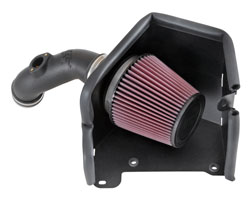
The K&N 63-5506 AirCharger is a simple, easy , turn-key upgrade

The AirCharger accommodates the OE MAF and crank case vent hose, so no reprogramming is required

The engines for both the 2015 - 2016 Mitsubishi Lancer and the fearsome EVO models were the result of a joint development project between Chrysler, Hyundai, and Mitsubishi, under the name of GEMA (Global Engine Manufacturing Alliance). The initial design of the engine block and cylinder head was handled by Hyundai.

The engine design features an aluminum block with cast-iron cylinder liners, with an aluminum cylinder head with a four valve per cylinder, double overhead camshaft layout. Mitsubishi independently developed the intake and exhaust manifolds, intake and exhaust ports, and other elements related to engine tuning for its 4B1 version of the engine.

The 2.0L version of the engine, named the 4B11, features a 1:1 bore:stroke ratio (3.38 inches each) which is referred to as square. According to Mitsubishi, these cylinder dimensions allow the engine to develop peak power at relatively high 6500 rpm, and to provide more linear power delivery and a wider torque curve for better flexibility while driving.

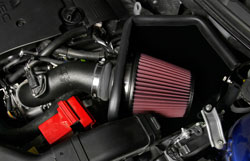
Much of the performance increase can be attributed to the oversized conical air filter

The included heat shield keeps power-robbing hot engine air out of the intake tract

The 2.4L 4B12 engine achieves its increased displacement by the use of a slightly wider bore of 3.46 inches and a longer stroke of 3.82 inches, accounting for the larger engine displacement. Mitsubishi was among the first companies to recognize the need to balance the vibrational forces of a four-cylinder engine and snapped up the patent for a counter-rotating balance shaft (which it later licensed to Porsche, among others). As engineers have gotten better at balancing forces, there's less need for additional balancing. For example, the 4B12 features only a small counter-rotating balance shaft operating off the oil pump drive.

And while the architecture of the 4B11 and 4B12 shares much with the powerful EVO engines, upgrading them to deliver EVO levels of horsepower and torque would be a difficult and expensive task. There is a way to improve the performance of your 2015 - 2016 Mitsubishi for less than the cost of a quality putter: the K&N 63-5506 AirCharger air intake system. The system has been chassis dyno-tested to demonstrate an estimated 5.41 horsepower gain over an otherwise stock 2015 2.4 L Mitsubishi Lancer.

The K&N 63-5506 AirCharger air intake system replaces the restrictive factory air filter and air intake housing on 2015 - 2016 2.0L and 2.4L Mitsubishi Lancer models. K&N AirChargers significantly reduce restriction to incoming air flow as well as reduce turbulence in the intake tube. This allows your engine, with each intake stroke, to draw a larger volume of air than the factory air filter assembly would provide. Air is then directed through an aerodynamically-verified intake tube into the engine's throttle body for a guaranteed power gain. The intake tube accommodates the factory mass air sensor and crank case vent hose.

K&N cold air intake system installed in truck video link

Click here to watch a video about K&N cold air intake systems

Much of the performance increase can be attributed to the oversized conical air filter manufactured from multiple layers of oiled cotton filter media which offers less resistance than traditional filters. The multi-layered cotton filter material also filters out microparticles that could damage your engine. Each design is verified through K&N's in-house filtration testing lab, which adheres to ISO 5011 standards, ensuring that K&N filters provide high airflow without putting engine protection at risk.

Best of all, the K&N AirCharger air intake system can be installed in 90 minutes or less with simple hand tools like a ratchet set, a few screwdrivers, and a couple of wrenches. All tools required are listed in the clear, step-by-step photo-illustrated instructions specific to your car that come included in the package.

Once you've installed your K&N filter you've eliminated the need to buy another air filter for the life of your covered 2015 - 2016 Lancer. The only maintenance is a service you can do yourself in no time at all. At intervals of 100,000 miles (depending upon your driving conditions) use the K&N 99-5000 recharger kit to easily clean your AirCharger air filter, preparing it for another 100,000 miles of driving. The K&N air filter you purchase is designed to last for the lifetime of your vehicle, which K&N guarantees will perform for up to 10 years or 1,000,000 miles without requiring replacement.

the K&N 63-5506 fits the following vehicles:

2016 MITSUBISHI LANCER 2.4L L4 Fuel Injection - w/Manual Trans.
2016 MITSUBISHI LANCER 2.0L L4 Fuel Injection - w/Manual Trans.
2015 MITSUBISHI LANCER 2.4L L4 Fuel Injection - w/Manual Trans.
2015 MITSUBISHI LANCER 2.0L L4 Fuel Injection - w/Manual Trans.

For all intakes for Lancer models visit the Mitsubishi Lancer Air Intakes page.

clear

K&N PRODUCT SEARCH     WHERE TO BUY K&N

2016 Suzuki GSX-S1000 and 1000F Motorcycle Air Filter Boosts Airflow

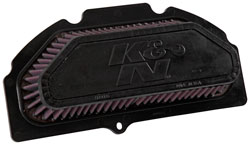
K&N SU-9915 washable and reusable air filter

The K&N SU-9915 is designed to fit in the air boxes of 2016 SUZUKI GSX-S1000 motorcycles

Originally created in 1909 to manufacture weaving machines, Suzuki started manufacturing cars in 1937 and by 2011 was believed to be the ninth largest automobile maker in the world. The Japanese company manufactures automobiles, four-wheel drive vehicles, motorcycles, all-terrain vehicles, outboard marine engines, and an assortment of small internal combustion engines.

Through the years, Suzuki has introduced more than 100 motorcycle models in a wide range of types including cruiser, dual-sport/off-road, minibike, motoGP, motocross, motocross/off-road/dual-sport, motocross/off-road, off-road, scooter/moped, sport, street, touring, touring/sport touring, and concept/prototype.

Its street types consisting of the GSX-Series includes a number of models that are favorites of motorcycle enthusiasts, especially the GSX-S1000 and the GSX-S1000F. The two models are almost identical except for twin headlights and a fairing on the F. Just last year Suzuki celebrated the 35th anniversary of the debut of the GSX range and the 10th anniversary of the introduction of the GSX-R1000 K5 engine that runs many of the GSX bikes.

It so happens that a 999 cc GSX-R1000 K5 engine powers both the 2016 Suzuki GSX-S1000 and GSX-S1000F. The engine, which generates 146-horsepower at 10,000 rpm and 80-lb-ft of torque at 9500 rpm, features a long stroke and a bore and stroke of 73.4 x 59mm that permits a compact combustion chamber and FEM (Finite Element Method) flat-top pistons that are 3% lighter than the pistons in the previous model. There are also new camshafts that are intended to enhance the valve timing for the street and new Iridium spark plugs with a more intense spark strength for more efficient combustion that delivers more power and linear throttle response and permits easier start-up and a more stable idle.

The K&N SU9915 Air Filter for the 2016 Suzuki GSX-S1000 and 1000F motorcycles.

The K&N SU-9915 Air Filter is washable and reusable and lasts for 50,000 miles between washings.

Both bikes also include four-piston Brembo monoblock calipers with dual 310mm rotors that are shared with the current GSX-R1000.

An LCD dash displays readouts for speed, TC setting, trip, time, gear position and tach.

K&N offers the SU-9915 replacement air filter for both the 2016 Suzuki GSX-S1000 and GSX-S1000F. The filter includes a multilayered cotton gauze pleated media that has been treated with a special grade of filter oil that makes the cotton strands so sticky they can capture and hold tiny contaminants. The pleated media offers more surfaces on which to trap the contaminants resulting in better filtration allowing for longer intervals between servicing.

There are a number of reasons why the oil treated cotton gauze media offer better filtration with less high airflow restriction than paper air filters. Paper air filters must be thick and/or the fibers must be tightly compressed and dense for them to meet minimum filtration standards. This results in more restrictive airflow. In addition, as a paper filter becomes clogged, the pressure inside the filter drops while the atmospheric air pressure outside the filter remains the same. An excessive high-pressure differential can cause dirt particles to be pulled around the paper medium and could get inside and damage the engine.

The K&N SU-9915 air filter is washable and reusable. K&N offers the 99-5000 air filter cleaning kit that is formulated to cleanse the filter and recharge it so that it can be used over and over again. In fact, the air filter is designed to last for the lifetime of your vehicle.

K&N is so sure of the quality of its air filters, it backs them with a 10-Year/Million Mile Limited Warranty®. The contract guarantees that the air filter will perform for up to 10 years or 1,000,000 miles without requiring replacement.

The SU-9915 air filter is designed for the following vehicle applications:

2016 SUZUKI GSXS1000F ABS 999 - All Models
2016 SUZUKI GSXS1000 ABS 999 - All Models
2016 SUZUKI GSXS1000 999 - All Models

clear

K&N PRODUCT SEARCH     WHERE TO BUY K&N

Cody Rahders Looks to Build on Experience from Challenging Baja 1000

The Cody Rahders Racing Polars RZR charged from 6th to 2nd in the Baja 1000's opening miles.

K&N-sponsored driver Cody Rahders competed in his Polaris RZR XP 1000 in the 2016 Baja 1000

Few races match the brutal nature of the Baja 1000, which sends teams ripping down Mexico’s Baja Peninsula for more than 1,000 miles of bone-shaking terrain. K&N-sponsored driver Cody Rahders learned Baja’s treachery first-hand in his Polaris RZR XP 1000 during the 2016 Baja 1000, but the young mechanical engineering student is already forging the lessons from his Did Not Finish status into a stronger path through 2017.

Cody has driven in off-road races for years, primarily running short-track sprint races in the Lucas Oil Regional Off-Road Series with a variety of vehicles in the Superlites, Pro Lites, and the UTV classes. That included a pair of Production 1000-class championships in his RZR, but Cody and his dad, Doug (the only other full-time team member), decided to go big in 2015 with a first visit to the Baja 1000 run by SCORE International Off-Road Racing. They entered their RZR as a Class 19 UTV and while they didn’t finish their first Baja in 2015, the Rahders decided to run a full season of desert racing in 2016.

“We decided to change our game and step it up a little bit,” Cody said. “I love Mexico, love the people and love racing there...I went from racing 20 minutes to being in the car for maybe 15 hours. It’s nothing to take lightly.”

In 2017, Cody Rahders will return to short-track racing in the Lucas Oil Off-Road Racing Series.

2016 was Cody Rahders first full season of desert racing after winning 7 short-track off-road titles

Cody weathered that transition nicely. In 2016, that included a steady run at the famous Mint 400 near Las Vegas, where he competed for a podium position until an exhaust failure and, consequently, an oil-line failure knocked him from the race. He followed that Mint 400 run with three SCORE events: the Rosarito Beach Desert Challenge, the Baja 500, and the Baja 1000. Cody finished 9th place in the Baja 500 but managed his first desert-race podium at the Rosarito Beach Challenge with an impressive third place.

The 1,000-mile race, however, proved to be a greater challenge. The initial plan was to have co-driver James Hill drive the opening hours of the race with Cody taking over at around Mile 400. James left the starting line in sixth place but quickly picked up several positions to reach second place. Around Mile 80, however, he came across a bottleneck in the road and, in trying to go around it, the RZR ended up getting hit by a larger Class 10 Buggy that had caught up from the bottleneck. That hit broke the axle at the time, but it wasn’t apparent when James took fuel and service at Mile 90.

The RZR pressed on until the axle failed six miles later. The team’s chase truck found the Polaris and the team were able to fix the destroyed hub, though it took several hours. Wanting only to finish, they persevered, but a later service stop was soon required when James’ co-driver became ill from bad food or the brutal terrain (possibly both). Cody took over as co-driver with more than 900 miles remaining and nearly 300 until he was scheduled to take over as driver.

“I love Mexico, love the people and love racing there," K&N-sponsored driver Cody Rah

Cody Rahder's RZRs use K&N air filters, oil filters, clutch air filters, and fuel-cell vent filters

“I was so stressed out that the only way I was going to calm down was to get in,” Cody said. “So I got in the passenger seat and I was going to then get in the driver’s seat still at around Mile 400. It was a little crazy, but I was down for the challenge.”

Before Cody could drive, however, disaster struck. At around Mile 165, the vehicle they were following braked hard and James swerved to miss it. The road jogged at that point on an off-camber curve and with soft, loose dust to the outside of the corner, the Polaris dug in and rolled over. The crash bent the lower control arm and with no replacement on hand, the team did everything they could to reshape it with hammers, rocks, jacks, and even the chase truck by driving over it. Unable to fix their stricken Polaris, the team had to withdraw from the race. While heartbroken by the retirement, Cody knows the learning curve couldn’t be steeper than at Baja.

“I thought we were done after the first time we broke, but we were able to fix it,” Cody said. “It’s a definitely a bummer, but that’s Baja.”

“It’s a definitely a bummer," Cody Rahders said, "but that’s Baja."

Cody Rahders retired from the 2016 Baja 1000, but he gained valuable desert-racing experience

For 2017, Cody Rahders will be back in the Polaris RZR XP 1000 with which he won two of his seven career championships. With the 1000 cc UTV class now part of the national Lucas Oil Off-Road Racing Series, Cody has plans to return to short-track racing and go hammer-and-tongs with the Yamahas that have dominated UTV class in the regional series lately. With a solid track record of his own in the UTV classes, Cody said he’s ready to battle with the Yamahas, starting his season with a shakedown in mid-January.

With a full engineering course load at Cuyamaca College to balance with racing, Cody’s unsure about his plans for longer-distance races in 2017. However if he’s racing down the Baja Peninsula next November, expect to see a more measured, mature approach from him.

“I think the biggest thing we learned was just just taking your time. You don’t really have to press as hard as you’d think. People break and aren’t going as hard as you think they are,”

Cody said. “We did good with what we had, but we lacked in areas where experience would have really helped.”

clear

K&N PRODUCT SEARCH     WHERE TO BUY K&N